The Dire Wolf Got the Headlines. The Bigger Story May Be Saving Species Before They Disappear.
The technology being developed to reach backward toward extinct species is increasingly being pointed in the other direction: toward animals that are still here, but may not remain here without help.

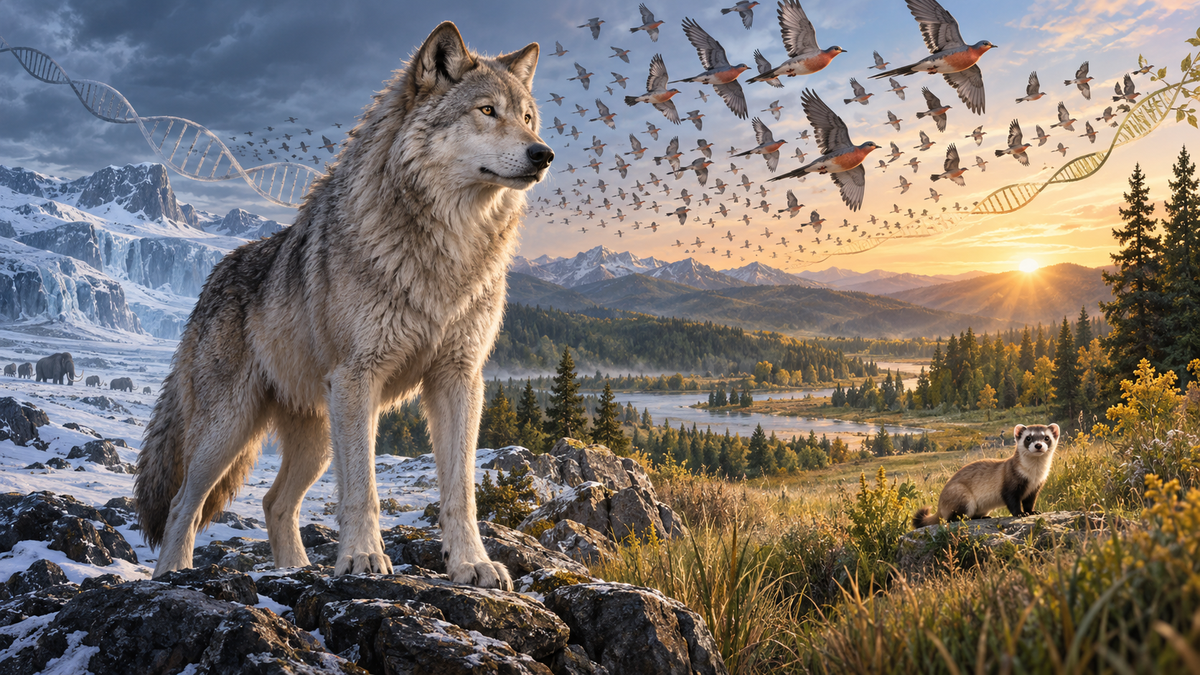
In April 2025, a biotechnology company called Colossal Biosciences made international headlines with three unusual wolf pups.
Romulus and Remus had been born the previous October. A female, Khaleesi, followed in January.
Colossal described them as the first animals produced through what it calls “de-extinction” of the dire wolf, an Ice Age predator that disappeared more than 10,000 years ago.
The company reconstructed parts of the dire-wolf genome using ancient DNA taken from a 13,000-year-old tooth and a 72,000-year-old skull. Scientists then made 20 targeted edits across 14 genes in gray-wolf cells before creating embryos that were carried by surrogate dogs.
Whether those animals should literally be called dire wolves remains a matter of scientific debate. They are not genetic copies of the extinct animal. They are gray wolves carrying selected genetic traits associated with dire wolves.
But that debate may be obscuring the more important story.
The technology being developed to reach backward toward extinct species is increasingly being pointed in the other direction:
toward animals that are still here, but may not remain here without help.
A company only a few years old
Colossal itself is remarkably young.
Entrepreneur Ben Lamm and Harvard geneticist George Church founded the company in 2021. Church had spent decades working at the frontier of genomics and genetic engineering, while Lamm brought the entrepreneurial side needed to turn some of those ideas into a heavily funded biotechnology company.
Their first great public ambition was the woolly mammoth.
But even that story has roots elsewhere.
Before Colossal existed, the nonprofit conservation organization Revive & Restore, founded in 2012 by Ryan Phelan and Stewart Brand, had already been exploring how emerging genetic technology might be used in conservation and de-extinction.
George Church participated in the organization’s first passenger-pigeon workshop at Harvard Medical School in February 2012. Revive & Restore later supported research and development on woolly-mammoth revival from 2013 until 2021, when the newly created Colossal took over that project.
So what sometimes appears to be a sudden new industry has actually grown out of more than a decade of overlapping scientific work.
And increasingly, that work is becoming less about bringing animals back.
It is becoming about keeping the ones we still have.
From de-extinction to preventing extinction
In June 2026, the U.S. Fish and Wildlife Service and Colossal entered a formal partnership to explore genomic science and biobanking for threatened and endangered wildlife.
The agreement focuses on preserving genetic diversity, improving scientific understanding of conservation genetics and exploring technologies that could strengthen recovery programs for species already at risk.
That is a very different goal from recreating an Ice Age predator.
It means collecting and preserving genetic material before populations become so small that important diversity disappears with them.
It also means scientists may eventually be able to reintroduce genetic traits into shrinking populations, strengthen disease resistance or restore breeding options that conventional conservation alone cannot provide.
Colossal has already been applying some of these tools to the critically endangered red wolf. The company says cloning and nuclear-transfer techniques could introduce genetic backgrounds into the captive breeding population that are not currently represented there.
And Colossal’s broader conservation work has continued expanding, alongside its better-known mammoth, dodo, thylacine and dire-wolf programs.
That may ultimately be the lasting value of the dire-wolf experiment.
Not whether three animals can perfectly recreate something lost 10,000 years ago, but whether the science developed in the attempt can keep another species from reaching zero.
A bird that once filled the sky
There may be no better warning about that number than the passenger pigeon.
It is difficult now to imagine how many there once were.
Smithsonian estimates place the passenger-pigeon population somewhere between 3 billion and 5 billion birds, making it one of the most abundant birds on Earth.
But numbers that large almost lose their meaning.
The historical descriptions make them real.
These were not flocks of hundreds or even thousands.
They could become moving landscapes.
Witnesses described migrations roughly a mile wide that took hours to pass a single location. Their wings could produce a roar loud enough to interfere with conversation. The birds sometimes darkened the daytime sky.
In 1813, naturalist and painter John James Audubon encountered an enormous migration while traveling toward Louisville, Kentucky.
The sky became so crowded with pigeons that daylight was dimmed. When Audubon eventually arrived in Louisville, some 55 miles away, the birds were still passing overhead.
They continued passing for three days.
At enormous communal nesting grounds, the birds crowded trees so densely that branches broke under their combined weight. One estimated Wisconsin nesting in 1871 covered hundreds of square miles and contained well over 100 million breeding adults.
Imagine standing beneath that.
Not watching a flock fly past.
Standing beneath a moving ceiling of living birds stretching beyond what you could see.
And then consider what happened next.
When being social became dangerous
Passenger pigeons had evolved around enormous numbers.
Their great flocks provided protection against natural predators. A hawk, fox or other predator could kill individual pigeons without making a meaningful dent in a population numbering in the billions.
But their greatest defense against nature became a terrible weakness when the predator became human.
Their intensely social behavior kept them together even under attack.
Historical accounts describe commercial hunts in which birds were being shot and falling from the flock while the remaining pigeons continued to stay together rather than simply abandoning the area.
Hunters did not need to track individual animals through a forest.
The birds gathered themselves by the thousands, millions and sometimes more.
Hunters used guns, enormous nets, burning sulfur and other methods to kill them. Telegraph lines allowed reports of major nesting locations to travel quickly. Railroads allowed professional hunters to reach those locations and ship barrels of pigeon meat to growing cities.
At one massive nesting in Petoskey, Michigan, in 1878, approximately 50,000 birds a day were killed for nearly five months.
Habitat destruction was happening at the same time as the eastern forests were cleared.
Their numbers collapsed.
The species apparently could not simply continue normally in tiny flocks. Its breeding, feeding and survival strategies had evolved around mass social behavior.
A creature that had survived through abundance eventually became vulnerable because of it.
The final known passenger pigeon was a female named Martha.
She died at the Cincinnati Zoo on September 1, 1914.
Billions became zero.
Trying to recover a piece of what disappeared
Today, Revive & Restore is attempting to reverse a small part of that history through a program it calls the Great Passenger Pigeon Comeback.
The organization is not attempting to clone a preserved passenger pigeon.
It can’t.
No living passenger-pigeon cells remain from which an animal could simply be cloned.
Instead, researchers are working with the passenger pigeon’s closest living relative, the band-tailed pigeon.
Their goal is to use genomic information recovered from preserved passenger-pigeon specimens to identify important genetic traits, introduce selected genetic sequences into band-tailed pigeon cells and eventually produce birds that resemble passenger pigeons not merely in appearance, but in behavior and ecological function.
Revive & Restore now hopes to hatch the first generation of these birds sometime in the 2030s.
Any eventual return to the wild would come considerably later.
First would come generations of breeding, behavioral study, ecological research and careful evaluation of what releasing such animals might actually do.
Because the goal is larger than creating an interesting bird.
Passenger pigeons once helped shape the forests they inhabited.
Their enormous, dense and constantly moving flocks disturbed vegetation, broke branches, moved nutrients and helped create a shifting patchwork of forest habitats.
Revive & Restore believes restoring some version of those behaviors could eventually recover ecological processes that disappeared along with the bird.
We already have evidence this can work
The most important evidence for genomic conservation, however, may not come from an extinct animal at all.
It comes from a small endangered mammal that is still very much alive.
The black-footed ferret was once believed extinct.
It was rediscovered in Wyoming in 1981, and an intensive captive breeding program helped save the species.
There was a problem.
Nearly the entire surviving population descended from only seven founders.
That creates an enormous genetic bottleneck.
But decades ago, scientists had preserved living cells from another female ferret named Willa, who died in 1988 without producing offspring.
Her genes had effectively disappeared from the species.
Her cells had not.
Revive & Restore and its partners eventually used those preserved cells to clone Willa.
A clone named Elizabeth Ann was born in 2020. Two more, Antonia and Noreen, followed in 2023.
Then something remarkable happened.
Antonia reproduced.
In 2024 she gave birth to two healthy offspring. More litters followed in 2025 from Antonia, Noreen and their descendants.
For the first time, genetic diversity from an animal that had died decades earlier without descendants had been returned to the breeding population of an endangered species.
Willa effectively became an eighth genetic founder of the modern black-footed ferret population more than 35 years after her death.
That is not de-extinction.
It may be something more immediately useful.
It is genetic rescue.
Two organizations, one increasingly important idea
Colossal Biosciences and Revive & Restore are different organizations with different structures and projects.
Colossal is a biotechnology company pursuing large, highly publicized de-extinction projects while increasingly applying the technologies developed through them to living species.
Revive & Restore is a nonprofit conservation organization that has spent more than a decade advancing genomic technologies for endangered species and ecosystems.
Ryan Phelan remains its co-founder and executive director. Stewart Brand remains a co-founder, and scientist Ben Novak leads its passenger-pigeon de-extinction effort and bird-conservation biotechnology work.
Their histories overlap.
Their work increasingly overlaps around one remarkable idea:
DNA may become another tool in the conservation toolbox.
For most of modern conservation history, saving a species has meant protecting habitat, stopping hunting, controlling invasive species, captive breeding and rebuilding populations.
Those things remain essential.
Genomics does not replace a wetland.
It does not replace a forest.
It cannot protect an animal from a bullet or prevent development from destroying its habitat.
But it may eventually give conservationists something they have never had before:
the ability to recover genetic diversity that otherwise would have been permanently lost.
With the black-footed ferret, that has already begun.
The lesson may not really be about resurrection
There is something deeply human about wanting to undo an extinction.
The passenger pigeon is particularly difficult to contemplate because its disappearance happened within recorded history.
People saw those skies filled with birds.
People described flocks that seemed endless.
And within the lifespan of a few generations, people watched one of the most abundant birds on Earth disappear.
The dire wolf vanished for very different reasons and on a vastly different timescale.
But both projects force scientists to confront the same question:
How much of a species can genetics restore?
Perhaps an even more useful question is:
How much can genetics help us preserve before restoration becomes necessary?
That possibility is becoming less theoretical.
The U.S. government is now formally exploring genomic conservation.
Private companies are investing heavily in the technology.
Conservation nonprofits are developing reproductive, cloning, biobanking and gene-editing techniques specifically for wildlife.
And every breakthrough developed while attempting something as audacious as rebuilding an extinct animal potentially becomes another tool available for an endangered one.
That is where the good news may really be hiding.
What still has to go right
There is an enormous distance between producing an animal in a laboratory and restoring a healthy species in the wild.
Genetic diversity must be maintained.
Animals must be healthy and capable of reproducing normally.
Suitable habitat has to exist.
Scientists must understand how genetically rescued or reconstructed animals will interact with existing ecosystems.
There are difficult ethical questions too.
Conservation funding is limited. Scientists and policymakers will have to determine when genomic intervention makes sense and when conventional habitat protection remains the wiser investment.
And de-extinction itself will continue to provoke arguments about what it actually means to bring a species back.
A genetically altered gray wolf is not a genetic copy of a dire wolf.
A modified band-tailed pigeon would not be genetically identical to the passenger pigeons that once crossed North America.
That distinction should remain part of the scientific conversation.
But it does not erase the underlying advance.
For most of human history, extinction represented an absolute biological wall.
Once the final animal died, its living genetic contribution was gone.
Today, researchers are beginning to discover that the boundary may be more complicated than we once believed.
Frozen cells can preserve possibilities for decades.
Ancient DNA can reveal genes that disappeared thousands of years ago.
Genetic diversity that vanished from a living population can, in at least some circumstances, be put back.
And technology created while attempting to reach across extinction may help prevent other animals from ever crossing that line.
That may ultimately prove more important than bringing anything back.
Because the best extinction story would still be the one we never have to tell.
Sources
- U.S. Department of the Interior, Interior Announces New Partnership to Advance Conservation of Imperiled Species Through Biobanking and Genomic Science
- Smithsonian Institution, The Last Passenger Pigeon and Martha, A Cold and Lonely Last Migration
- Audubon, Why the Passenger Pigeon Went Extinct
- Revive & Restore, The Great Passenger Pigeon Comeback and passenger-pigeon research materials
- Revive & Restore, Black-Footed Ferret Genetic Rescue
- Revive & Restore, organizational history and leadership
- Colossal Biosciences, company history and leadership