
A New Eye on the Universe Is Now on Its Way
NASA’s Nancy Grace Roman Space Telescope has begun a million-mile journey to reveal more of the universe at once—and its first critical milestones are already complete.

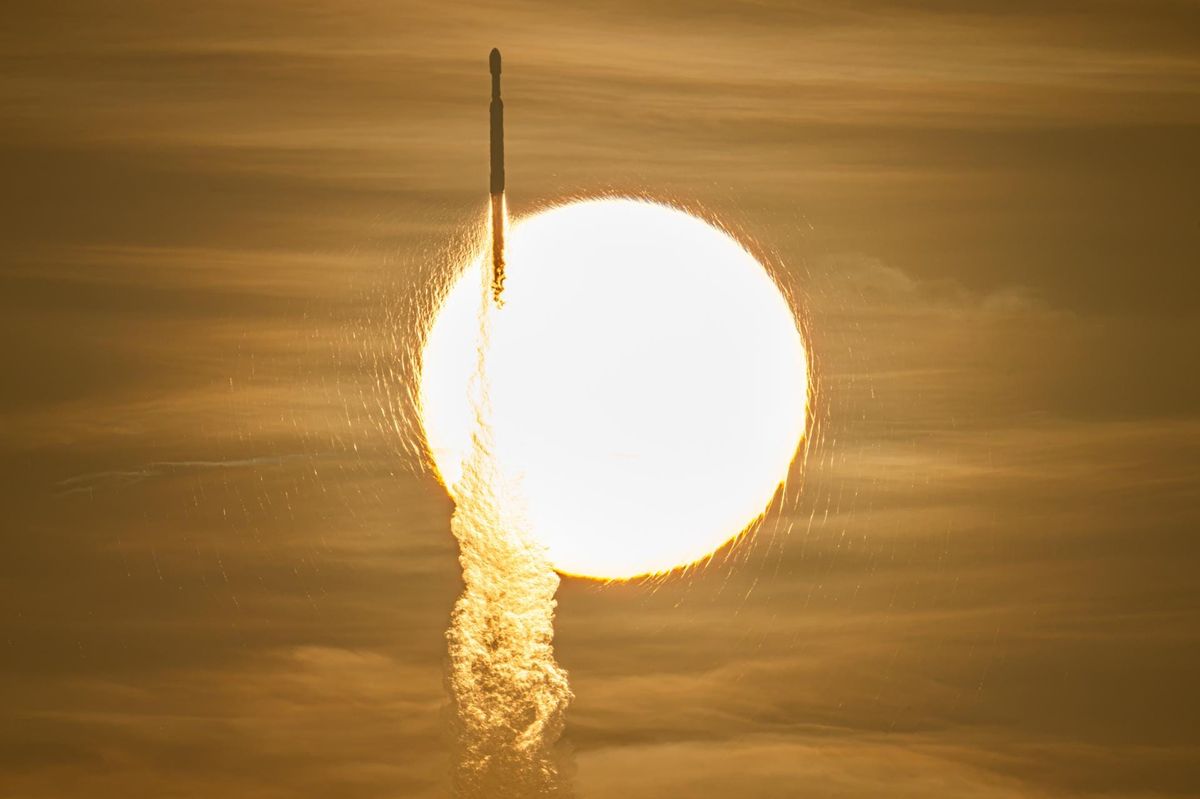
For a few seconds on Sunday morning, a Falcon Heavy rose directly across the face of the Sun. Inside it was a telescope built not simply to look farther into space, but to see much more of it at once.
NASA’s Nancy Grace Roman Space Telescope lifted off from Kennedy Space Center at 7:26 a.m. EDT on August 30. The successful launch began a journey of nearly one million miles toward a region of space known as the second Sun–Earth Lagrange point, or L2.
Roman is named for NASA’s first chief astronomer, who helped make large space observatories—including Hubble—possible. The telescope that now carries her name is designed to widen humanity’s view again.
What went right
The launch vehicle performed as expected, and Roman separated from the rocket about 31 minutes after liftoff. Ground controllers began receiving telemetry within minutes, confirming that the observatory was communicating as it started traveling on its own.
The progress continued after launch. Roman completed its first trajectory-correction burn, keeping it on course for L2. Its high-gain antenna and visor-like sunshade deployed successfully. The antenna will carry commands and health information while eventually transmitting an enormous stream of scientific data back to Earth.
On September 1, the team also powered on Roman’s Coronagraph Instrument. The device is designed to block the overwhelming glare of nearby stars so scientists can observe the much fainter planets and dusty disks around them.
A wider way of seeing
Roman’s primary mirror is 7.9 feet across—the same diameter as Hubble’s—but its view will be dramatically wider. NASA says Roman’s 300-megapixel Wide Field Instrument can capture an area of sky 100 times larger than Hubble can in a single image while retaining similar sensitivity and infrared resolution.
That combination is expected to let Roman survey the sky as much as 1,000 times faster than Hubble. Instead of concentrating only on narrow sections of space, it will repeatedly observe enormous populations of galaxies, stars and planets. The telescope is expected to return about 1.4 terabytes of data each day, more than any previous NASA astrophysics mission.
Scientists will use those observations to investigate two of the largest unanswered questions in astronomy: dark matter, which appears to provide much of the universe’s unseen structure, and dark energy, the name given to whatever is driving the universe’s expansion to accelerate.
Roman will also search for planets beyond our solar system. Its wide surveys could reveal thousands of worlds through changes in starlight and gravitational microlensing. Its coronagraph is a technology demonstration, not yet a machine for finding another Earth, but the techniques it tests could help future telescopes take clearer pictures of smaller planets.
Why this counts as progress
The achievement is larger than a successful launch. More than a decade of engineering has produced an observatory that is now operating, communicating and moving toward its destination. Several risky early milestones—separation, power, communications, trajectory correction, antenna deployment, sunshade deployment and coronagraph activation—have already been completed.
Roman will not replace Hubble or the James Webb Space Telescope. It adds a different ability: gathering detailed information across much wider areas. That means more objects observed, more changes caught as they happen and a better chance of finding things no one knew to look for.
What still has to go right
Roman’s promise is not yet the same thing as a scientific result.
The observatory must complete its journey and enter its planned orbit around L2. Engineers still have to activate the Wide Field Instrument and spend the remainder of the roughly three-month commissioning period cooling, calibrating and testing the spacecraft and its instruments.
Every system must continue working in an environment nearly a million miles from Earth, where repairs cannot be made by visiting astronauts. NASA currently expects Roman’s first images in early 2027. Until then, the mission remains a remarkable piece of working technology with its most important discoveries still ahead.
Sources and further reading
- NASA: Roman Space Telescope launch report
- NASA: Roman mission overview
- NASA: First mid-course correction
- NASA: Antenna and sunshade deployment
- NASA: Coronagraph Instrument activation
What’s Going Right Today independently reviewed and synthesized the NASA sources linked above. No quotations or passages were reproduced from another publication.
Feature image: Falcon Heavy carrying Roman across the Sun during launch. Photo: NASA/John Kraus. Source: NASA Image and Video Library. Used under NASA’s media usage guidelines.